Specialized Courses for PhD Students
- Ethnology of the Balkans
- Migrations Between Balkans and Ottoman Empire / Turkey: Models, Social Networks and Identities
- Anthropology of Migrations
- Traditional Institutions and Normative Culture on the Balkans
For further information click here.
Past Courses and Seminars
Seminar “Contemporary Dimensions of Identities”
Lecture 1: “Religion and Identity” (in Bulgarian)
Lecture 2: “The State, Motherland and Identity” (in Bulgarian)
Lecture 3: “Contemporary Dimensions of the Bulgarian Citizens’ Identity” (in Bulgarian)
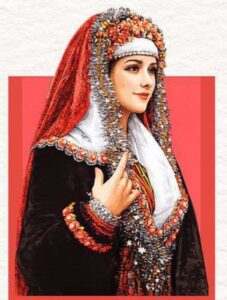
The programme is designed to introduce participants to the ethnic, cultural, and religious diversity of Bulgaria through a combination of lectures, ethnographic field visits, and discussions with local communities and experts. The itinerary includes Sofia, Breznitsa, Ribnovo, Plovdiv, Bachkovo, and Sliven.
The lectorium is open to PhD students and early-career researchers (up to five years after PhD) working in the fields of anthropology, ethnology, sociology, history, cultural studies, and related disciplines.
Participation is free of charge. The organisers provide accommodation, meals, in-country transport, and full access to the academic programme. Participants are expected to cover their international travel costs.
For futher information, please click here.
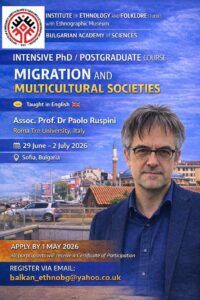
Migration and Multicultural Societies
Intensive PhD/ postgraduate class
29 June – 2 July 2026
Lecturer: Dr. Paolo Ruspini
Associate Professor at Roma Tre University (Università degli Studi Roma Tre)
The course aims to foster curiosity and interest in migration phenomena, cultural diversity, and their management through a process of self-reflection and discussion based on bibliographical, ethnographic, and audiovisual materials. Students will be invited to present their experiences and reflections to refine their positions on the perception and reality of contemporary migration, and on the role of policies and practices of government and non-government actors responsible for managing it at the local, national, and international levels.
Upon completion of the course, students will:
– have become familiar with the complexity of migration phenomena and their management in contemporary societies
– have developed the ability to self-reflect and re-elaborate their experiences and knowledge on migration
– be able to critically navigate the various approaches to social inclusion and multiculturalism.