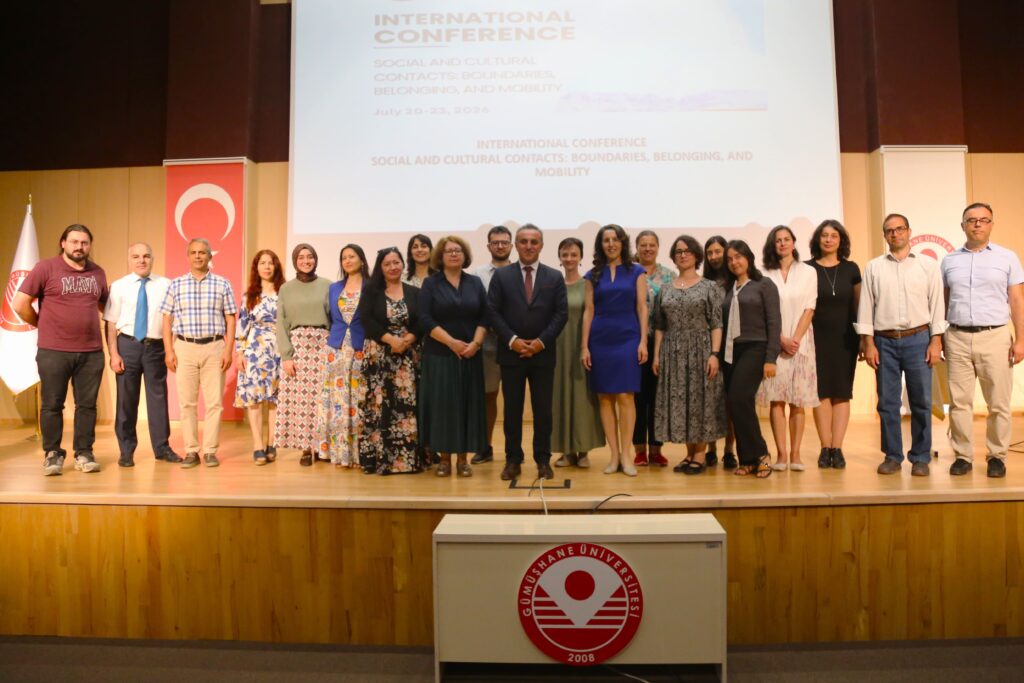
Members of the Balkan Ethnology Department took part in the international conference “Social and Cultural Contacts: Borders, Belonging and Mobility”, held at Gümüşhane University, Türkiye, from 20 to 23 July 2026. The conference was organised jointly by Gümüşhane University and the Institute of Ethnology and Folklore Studies with Ethnographic Museum at the Bulgarian Academy of Sciences (IEFSEM–BAS). It brought together 26 scholars from Türkiye, Bulgaria, Russia, Iran, Estonia, North Macedonia, Germany and Austria.
The four-day hybrid conference offered a platform for interdisciplinary exchange between sociology, ethnology and cultural studies. Its programme covered migration and mobility, borders and belonging, ethnic identities, volunteering, cultural interaction, digital transformation and museology.
The department was involved in both organising the conference and its academic programme. Assoc. Prof. Mila Maeva, PhD, and Assoc. Prof. Yelis Erolova, PhD, served on the organising committee with colleagues from Gümüşhane University. The department’s papers reflected the broad thematic scope of its current research.
Assoc. Prof. Maeva presented “Volunteering in Bulgaria: Institutional Development, Social Participation, and Contemporary Challenges”. She traced how volunteering has developed in Bulgaria and discussed its institutional framework and the forms of civic engagement it involves.
Volunteering and transnational solidarity were also the focus of Assist. Prof. Plamena Stoyanova, PhD. Her paper, “The Contribution of Bulgarian Volunteers in Rescue Efforts After the 2023 Earthquake in Turkey and Syria”, discussed the role Bulgarian volunteers played after the devastating disaster.
Assoc. Prof. Erolova brought a historical perspective on cross-border mobility with “Bulgarian Medics ‘Rewarded’ with a Trip to Ukraine in 1986”. Her paper examined the experiences of Bulgarian medical professionals sent to Ukraine in the late socialist period.
Rositsa Baltadzhieva, PhD student, examined the relationship between language, identity, and social boundaries in “Language as a Social Boundary: Ukrainian–Russian Language Practices in the Context of War”. Focusing on Ukrainian–Russian language practices in the context of the ongoing war, her contribution explored how language can function as a marker of belonging and difference and how linguistic choices acquire new social and symbolic meanings in times of conflict.
PhD student Polina Trifonova turned to historical memory, identity and state policy towards minorities in “The Name Change Process in Bulgaria in the 1980s: A Case Study on Crimean Tatars in Shumen Region”. Her paper explored how Crimean Tatars in northeastern Bulgaria experienced the state-imposed name-changing campaign.
Assist. Prof. Behrin Shopova, PhD, addressed contemporary changes in religious life in “Mawlid Rituals in Digital Contexts: Participation, Visibility, and Transformation of Religious Practice”. She looked at how digital environments affect participation in religious practices, the way they are represented and how they change.
Petya Dimitrova, PhD, presented “The Digital Nomad Bubble: Spatial Proximity and Socio-Cultural Distance in a Bulgarian Ski Resort”, which dealt with new forms of mobility. She showed that physical proximity between digital nomads and local residents does not necessarily close the socio-cultural distance between them.
Assist. Prof. Julia Popcheva, PhD, discussed the links between mobility, heritage and tourism in “The Camino de Santiago Pilgrimage between Cultural Heritage and (Over)Tourism”. She traced the tension between the Camino as a pilgrimage route and heritage site and the pressures that come with its growing popularity.
Inxhi Brisku, PhD, contributed a further perspective on digitalisation with “Challenges of Attending Online Lectures for Students of Public Universities in Albania”, which focused on the difficulties students face in online higher education.
Alongside the sessions, participants also attended a workshop at Gümüşhane University’s Digital Mining Museum on how digital technologies can help preserve and present cultural heritage.
The conference strengthened cooperation between IEFSEM–BAS and Gümüşhane University. It also opened a shared space for discussing how borders, mobility, belonging, digitalisation and cultural encounters shape communities and social relations, both historically and today.
Photo Credit: Gümüşhane Üniversitesi